Fossils & Metabolites

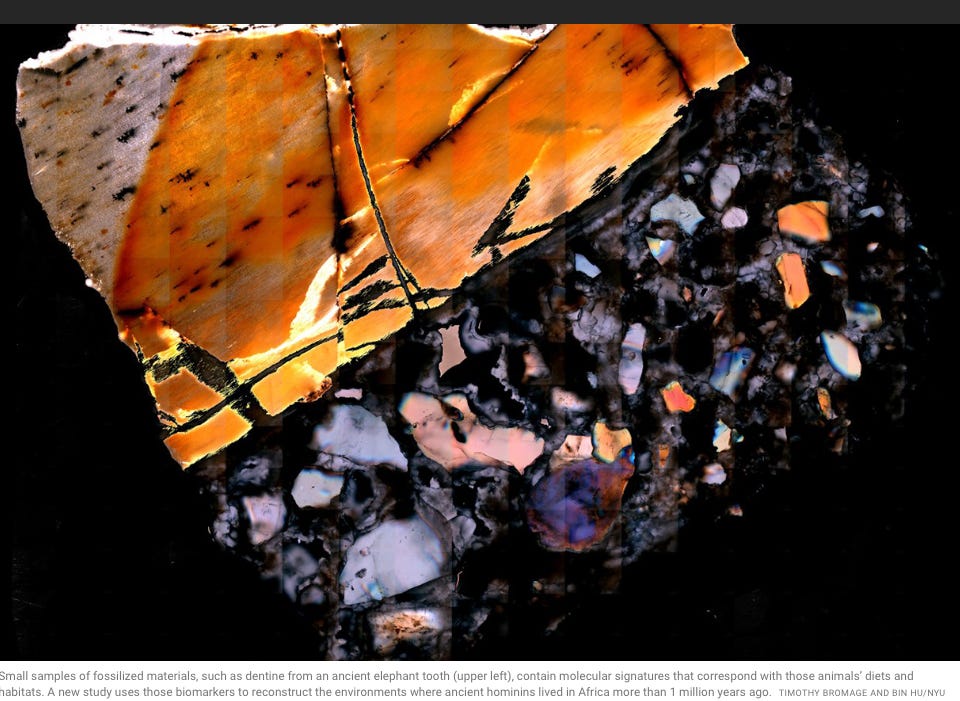
AAAS: “Chemicals in million-year-old fossils reveal animals’ lives in detail.” Some 2.4 M yrs ago, “a large + now-extinct elephant meandered along the grassy shores of Lake Malawi in East Africa…scientists know it was a juvenile that munched wormwood bark + mulberry leaves—and may have been fighting an infection when it died.” Forensic investigations. “In a study published earlier this month in Nature, scientists report that fossil bones and teeth from that elephant and other fossil animals dating back millions of years ago contain metabolites[compounds], tiny byproducts of internal metabolic processes.” The study “inaugurates paleometabolomics”—as the field is known—“as a robust, biomolecular tool for extracting … data from millions-of-years-old fossils.”
Tim Bromage, biologic anthropologist at New York University, + his collaborators studied “fossilized bones and teeth from animals excavated from areas near ancient hominin sites, including Olduvai Gorge in Tanzania, Makapansgat in South Africa, + Chiwondo Beds in Malawi.” Using a mass spectrometer, they compared metabolites to databases of compounds known to be made by similar living [extant] organisms. “Surprisingly, these analyses revealed thousands of metabolites in each sample, hundreds of which could be matched definitively to contemporary organisms.” Two gerbils and one squirrel from Olduvai Gorge contained metabolites associated with the genes that metabolize estrogens. “A squirrel from Olduvai Gorge, the elephant from the Chiwondo Beds, + a bovid from Makapansgat contained metabolites possibly associated with immune response to Trypanosoma brucei, the parasite that causes ‘sleeping sickness’ in humans.”
Finally, “in a 1.8-million-year-old squirrel from Olduvai Gorge, the researchers uncovered metabolites that illustrate a diet of asparagus + aloe—plants that indicate a dense forest canopy.” These beat anything coming out of those CSI show