Permafrost & Salmon

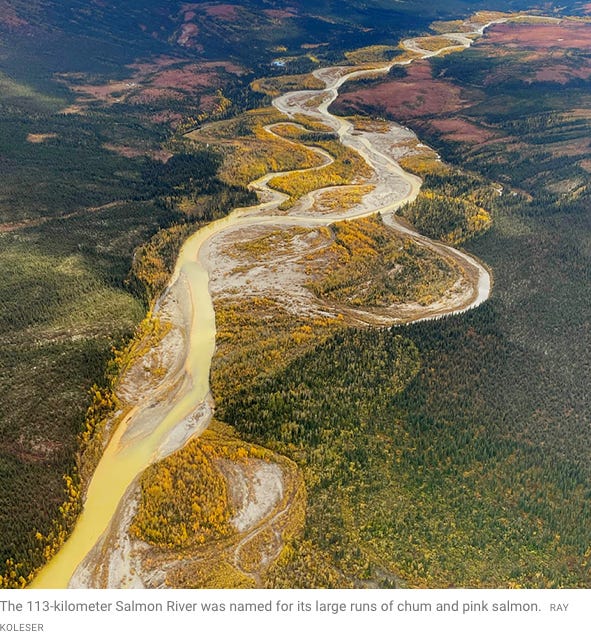
AAAS: “Thawing permafrost is turning Arctic rivers orange—spelling trouble for fish.” In 1977 author John McPhee wrote that the Salmon River, in remote northwestern Alaska, had “the clearest, purest water I have ever seen.” But in 2019, ‘the river turned orange and yellow, reminiscent of acidic runoff from mining waste.’ Times change: “the river and many of its tributaries are now laced with toxic metals, leached from thawing permafrost, at levels that can harm aquatic life, scientists report today in the Proceedings of the National Academy of Sciences.” The broader problem: “In 2024, scientists reported that at least 75 streams—including the Salmon—recently turned orange in the Brooks Range, the mountain chain that stretches east to west across northern Alaska.” Melting permafrost in some sites releases metals such as iron, in others thawing can expose bedrock rich in sulfides. “When the sulfides encounter water they can oxidize, forming sulfuric acid, which in turn dissolves metals trapped in the rock such as iron, aluminum, copper, and cadmium.” Paddy Sullivan, a University of Alaska Anchorage ecologist, ‘has found more than 500 places along the Salmon and surrounding watersheds where highly acidic water seeps from thawing permafrost, killing vegetation before flowing into waterways.’ He and his colleagues measured the abundance of 22 metals in water samples collected in 2022 and 2023 along the Salmon and 10 tributaries. “The river’s main stem and nine of its tributaries had at least one metal present above levels that would be toxic to water-dwelling organisms, according to U.S. Environmental Protection Agency standards.” At one spot along the main river, ‘levels of iron, aluminum, cadmium, copper, nickel, and zinc were between three and 37 times higher in 2023 than in samples from a decade earlier.’
Ironically, acidity in the main river + most tributaries had not increased because of buffering from limestone. But places with higher levels of iron + aluminum were often devoid of larval aquatic insects such as stoneflies + mayflies, a critical source of fish food. “Sullivan wonders whether the flush of toxic metals might be harming salmon populations, which began to decline in 2023.” However, Rose Cory, an aquatic biogeochemist at the University of Michigan who studies changes in Arctic waters, is ‘leery of drawing strong conclusions about trends of increasing metals and “rusting” rivers,’ as there are few historic measurements of metals in Arctic watersheds. As usual, more study is needed.