Sustaining Ancient Wheat Varieties

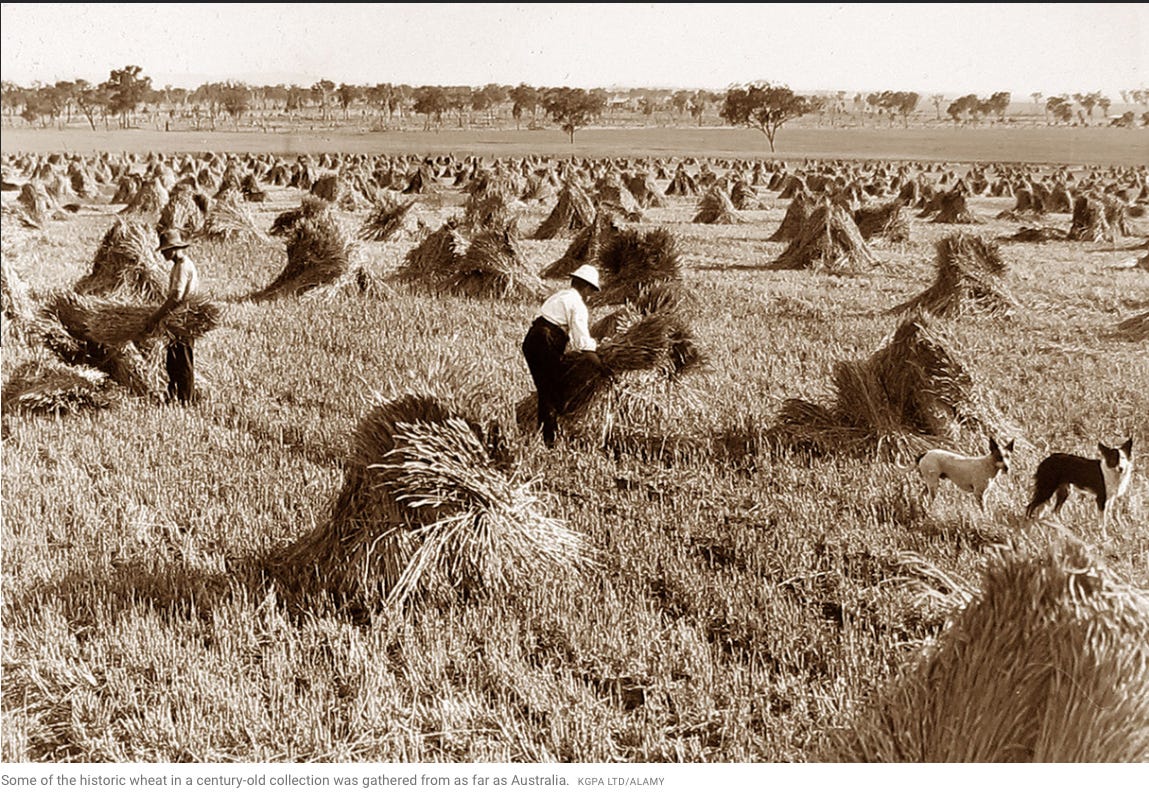
AAAS: "'Gold mine' of century-old wheat varieties could help breeders restore long lost traits." Modern commercialized wheat was developed in the 19th and 20th centuries, focusing on crossing + selectively breeding a few key varieties known as 'landraces.' Unsurprisingly, ultimately this left us with high-yielding landraces vulnerable to disease, heat, and drought—and dependent on frequent, excessive applications of fertilizers. One way to divert ourselves from this historic trend, according to 'a study published today by Nature, may lie in the genetic diversity in 827 kinds of wheat, many of them long vanished from farms.' Geneticist Jorge Dubcovsky of the University of California, Davis, who wasn’t involved in the study, says “This will be a fantastic new resource for the global wheat research community.” Key goals are reducing the need for nitrogen fertilizer and enhancing the resistance to 'wheat blast, a disease now threatening harvests in much of the world.' Historically, 'the landrace collection was assembled in England starting in 1924, when Arthur Ernest Watkins joined the University of Cambridge’s Plant Breeding Institute. Under his direction, "over 2 decades, consuls and business agents across the British Empire and beyond visited local markets and bought grain that had been grown in as many environments as possible, acquiring 7000 samples of wheat from 32 countries." Technically the wheat genome is 40 times larger than rice's, so a collaboration was established with evolutionary geneticist Shifeng Cheng of the Agricultural Genomics Institute at Shenzhen, which specializes in unraveling crop genomes. "In just 3 months Cheng’s team sequenced the 827 historic landraces, along with 208 modern varieties for comparison." Wow, look at that: Scientific cooperation across borders even at times of enhanced geopolitical tension. Efforts such as these both support science and help 'breed' trust. Part and parcel of the scientific enterprise.