US & Utility-scale Batteries

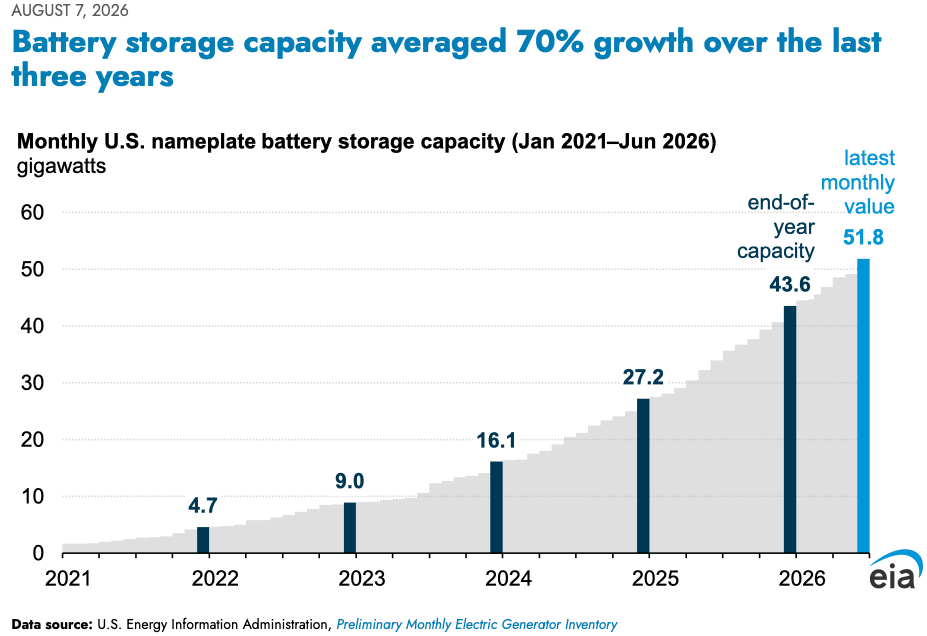
EIA: “Battery storage capacity averaged 70% growth over the last three years.”
‘Utility-scale battery storage capacity in US pole-vaulted over the Moon in last 3 years, with annualized average growth rate of 70%.’
“By end of 2025, U.S. had operational battery storage capacity of 43.6 gigawatts (GW).” During the first 6 months of 2026, operators added another 8.3 GW, based on EIA’s latest Preliminary Monthly Electric Generator Inventory.
“Operators anticipate bringing an additional 54 GW of battery storage capacity online over the next two and half years. Projections are for an additional 26 GW in 2027 + 14 GW in 2028, but I suspect this queue will expand, perhaps dramatically.
Recall also that this does not include all the distributed batteries in companies + homes, of which more + more will be made available for balancing the grid. I myself have been waiting impatiently in line for my own EV battery to get connected.
Solar plants host the largest battery storage capacity units. “The Bellefield Solar and Energy Storage Farm, which began operations in December 2025, couples 500 megawatts (MW) of photovoltaic capacity with 500 MW of nameplate power storage for the California Independent System Operator (CAISO).”
Plans for the Bellefield facility call for a doubling of the PV + storage capacity of the facility and for the new capacity to be operational by November this year. “If those plans materialize, the facility will become the largest power storage facility in the United States.”
Detractors will jump on this sort of post with the argument that batteries don’t actually ‘generate’ electricity. To forestall this argument, let me just say that I am happy to state that batteries ‘usefully release’ electricity. Hope this calms them down, as I am always aiming for civility.